

 Česky (EUR)
 Deutsch (EUR)
 Polski (EUR)
 български език (EUR)
How to choose the right dispensing tip for industrial applications?
In industrial liquid dispensing, the choice of dispensing tip is one of the most critical parts of the entire process. Even a minimal deviation in the applied amount can lead to increased scrap rates or material waste.
While the dispensing tip is the smallest and often the least expensive component of the system, it represents the final point of contact between the technology and the product. It defines the final shape, volume, and stability of the deposit.
A correctly chosen tip directly affects three key parameters:
Repeatability: The ability to apply the same amount of material every time.
Shape and Accuracy: Prevention of splashing, "stringing," and unwanted dripping.
Cycle Speed: The tip's resistance determines the required pressure and flow rate.
It can lead to pressure accumulation – dripping occurs after the cycle ends.
The material is excessively mechanically stressed – its physical properties may change (e.g., with two-component epoxies, filled pastes, or solder pastes).
Tip selection must therefore be based on its design, fluid properties, and application requirements.
1. Classification of tips by construction and application
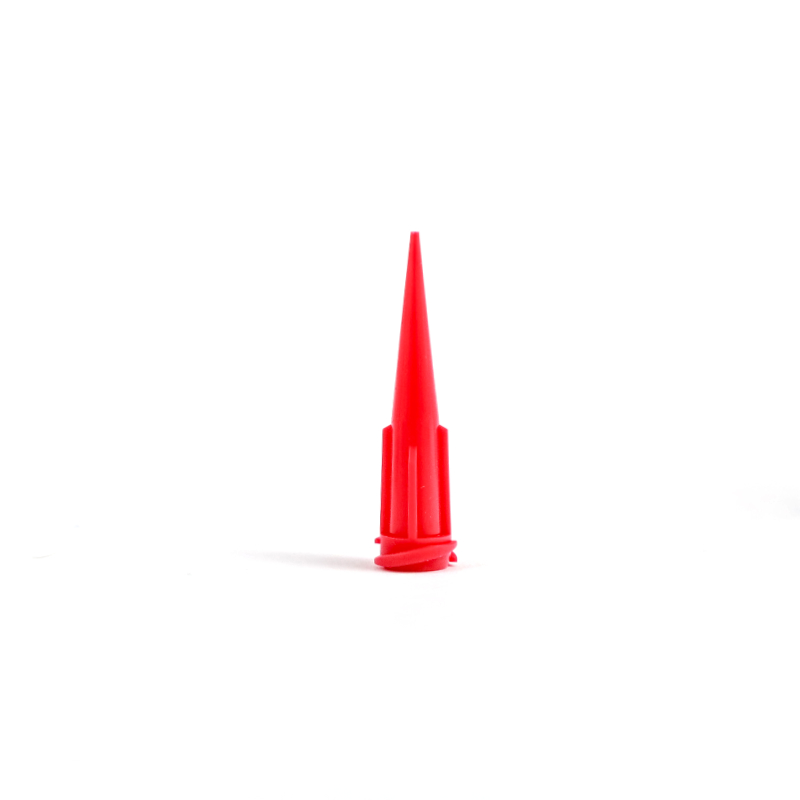
Tapered Tips (Smooth-Flow Tapered)
Made of polyethylene (often with UV block) or polypropylene. The conical shape naturally reduces flow resistance.
Suitable for:
- Medium to high viscosity materials
- Gel cyanoacrylates
- UV adhesives
- Sealants and filled materials
- Solder pastes
- Smooth flow of thick pastes
- Lower working pressure
- Minimal risk of clogging
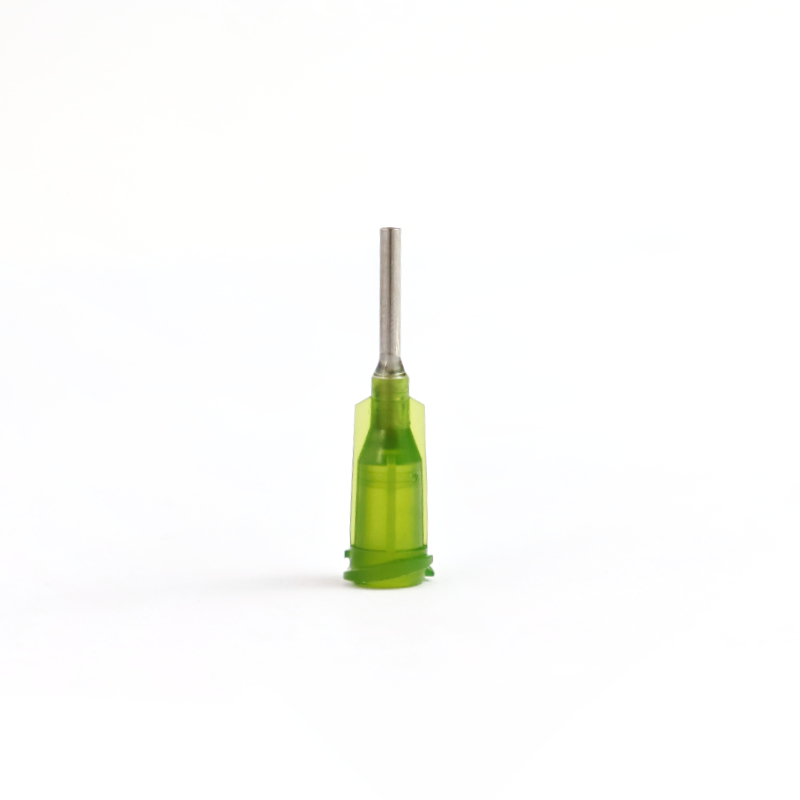
General Purpose Tips (Precision Stainless Steel – General Purpose)
Classic tips with a stainless steel cannula and a polypropylene hub (e.g., SafetyLok system).
Suitable for:
- Wide range of materials, especially low to medium viscosity fluids
- Precision micro-deposits (smaller diameters)
Variants: Straight, 45°, and 90° angled (for hard-to-reach areas).
- High precision
- Wide range of diameters and lengths
- Higher resistance with thick media
- Risk of clogging with fillers
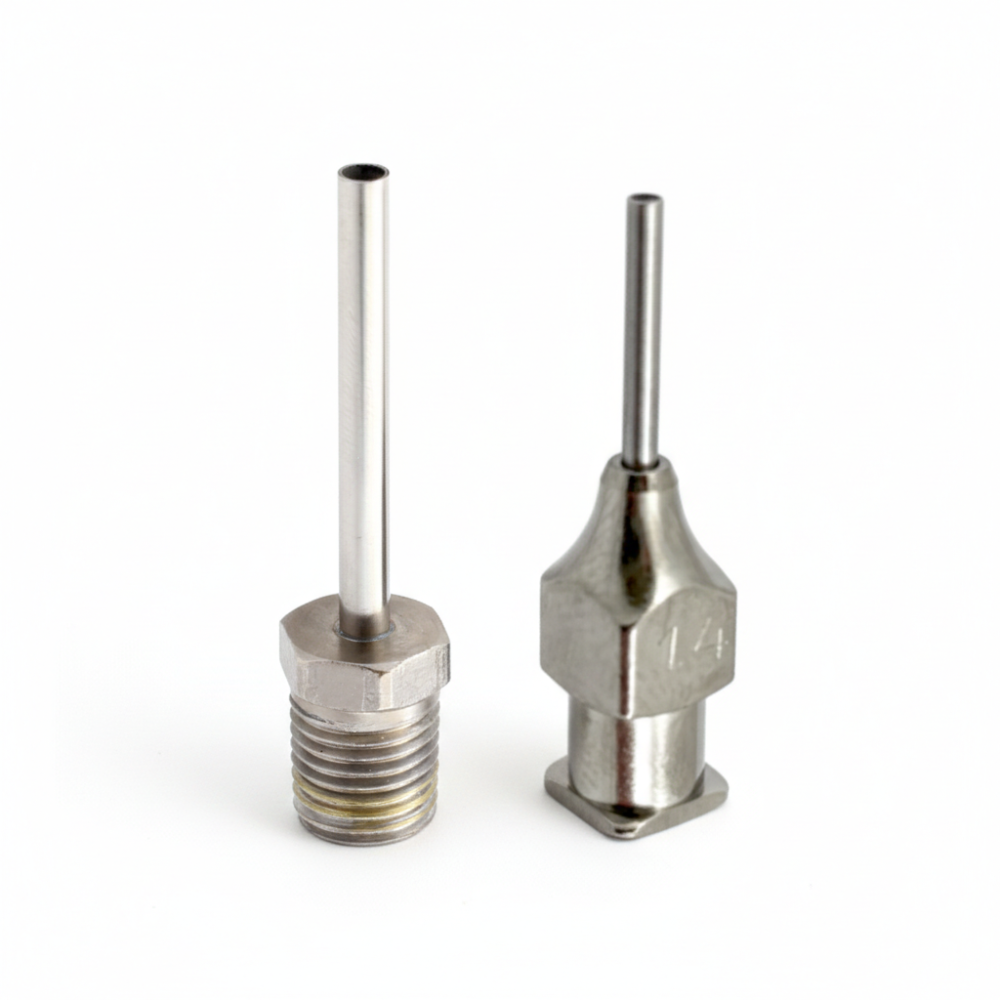
All-Stainless Steel Tips | 1/4 NPT Thread
Both the cannula and the thread are made of stainless steel.
Suitable for:
- Applications with chemical incompatibility of plastics
- Autoclave sterilization
- Easy cleaning for repeated use
- Available lengths up to 100 mm
- Suitable for industrial and medical applications
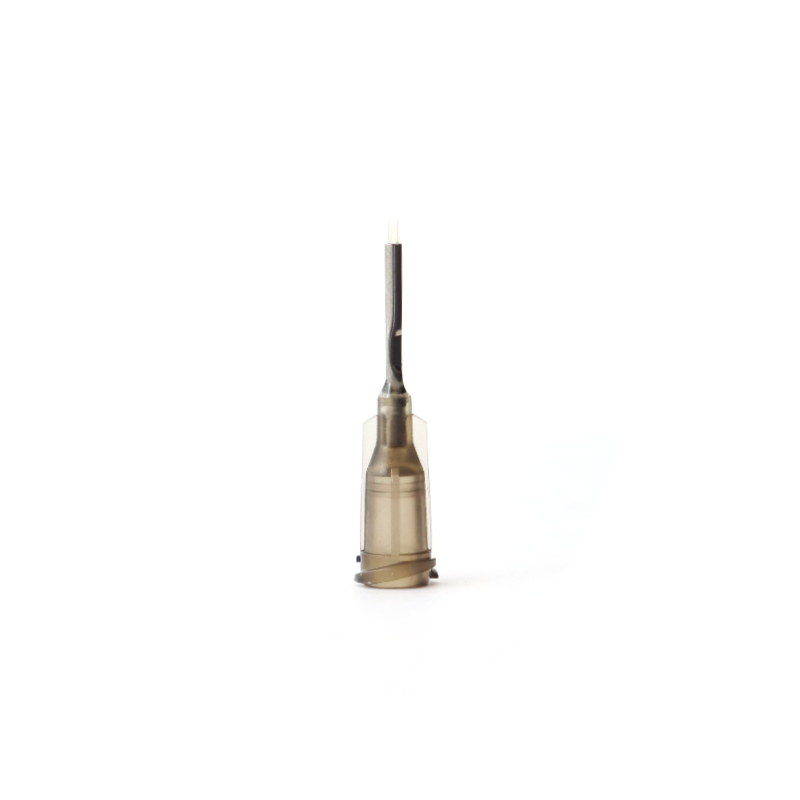
PTFE-Lined Tips (Teflon)
The inner part of the cannula is lined with PTFE material.
Best suited for:
- Cyanoacrylates (super glues)
- Very thin fluids
- Chemically aggressive substances
- Minimization of clogging and reduced reaction with metal
- Elimination of wicking of thin fluids
Specialty Tip Types
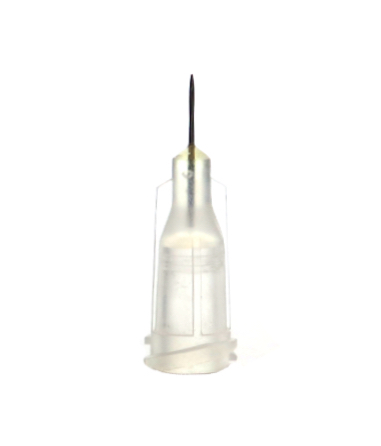
→ Micro-dots of very thin fluids and UV adhesives – clean deposit cutoff
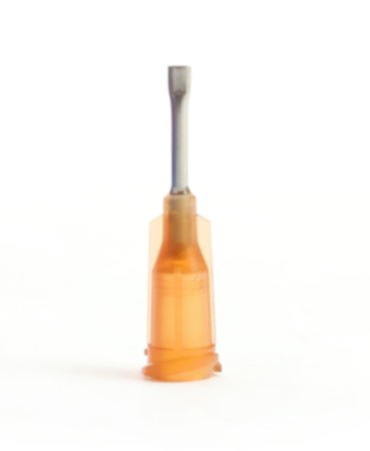
→ Flat ribbons of thick sealants, silicones, and epoxies
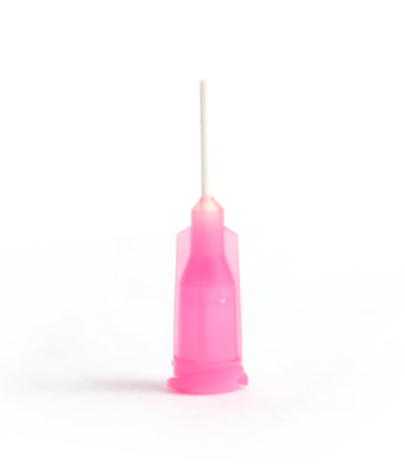
→ Pliable tubing for grooves and hard-to-reach areas
→ Ability to cut to the required length
2. Physics and Dispensing Optimization Strategies
Correct tip dimensioning is based on the physical laws of flow, resistance, and pressure.
Influence of Tip Length on Process Stability:
The longer the tip, the higher the resistance and the need for higher pressure. Accumulated pressure in a long tip causes dripping after the cycle ends.
Recommendation: Use the shortest possible tip (ideally 0.25”).
✔ Lower resistance | ✔ Less pressure accumulation | ✔ More stable dispensing
Diameter Selection (Gauge)
Diameter is indicated by the Gauge (G) value. Note: the higher the G number, the smaller the inner diameter.
Basic Rule: Select the largest suitable diameter that still allows for the required deposit size.
Practical Example:
If you want to dispense a dot with a 1 mm diameter, do not use a tip with an ID of 0.4 mm. A better choice would be, for example, G18 (ID ~0.84 mm).
The tip should always have a slightly smaller diameter than the required final deposit – not significantly smaller.
Strategy: Pressure and Time
1️⃣ Low Pressure: Use the lowest possible pressure. This reduces mechanical stress on the material and the risk of dripping.
2️⃣ Longer Dispensing Time: Instead of a short pulse under high pressure, choose lower pressure and a longer time.
Example: If you have a working cycle of 1s, do not use an unnecessarily short time (e.g., 0.2s) and high pressure. Set a longer time closer to the machine's cycle time.
Longer time + Lower pressure = ✔ More stable volume, ✔ Less variance, ✔ Better control
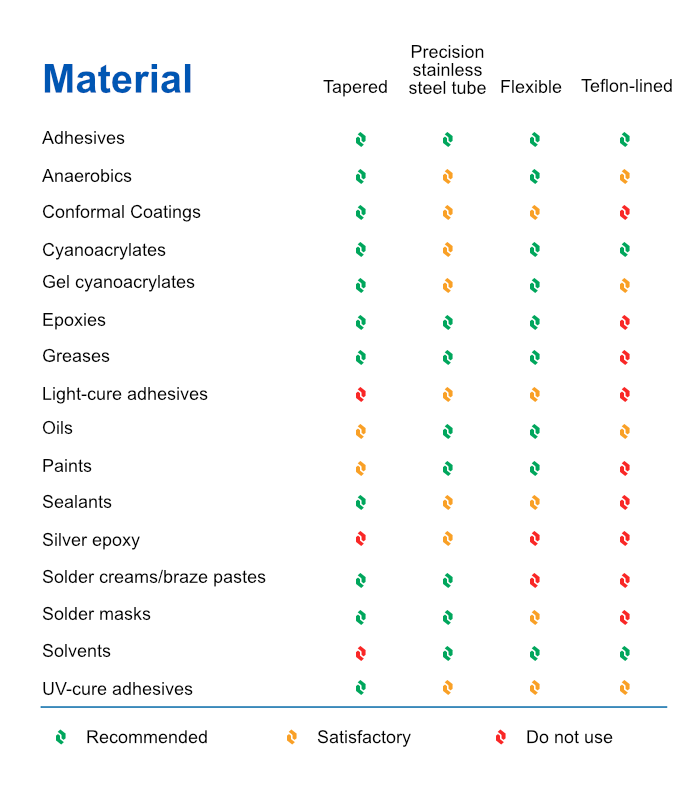
3. Compatibility Table: Material vs. Tip Type
Common Mistakes in Tip Selection
- ❌ Choosing a diameter that is too small for a thick material
- ❌ Compensating for an unsuitable tip by increasing pressure
- ❌ Ignoring fillers within the material
- ❌ Using one universal type for all applications
The Stable Dispensing Equation
- Shortest possible tip length
- Largest suitable diameter
- Lowest possible pressure
- Longest possible dispensing time
=
Minimal resistance, zero dripping, and maximum repeatability
Conclusion
The right dispensing tip increases precision, reduces scrap, stabilizes the process, and extends the life of the equipment.